Yoga for Violinistsviolin.yoga Send me Day/Set 1

Yoga for Violinists (and violists) · free for now

Day/Set 1, my gift to you

I want you to fall back in love with your violin

and for that love to permeate into every aspect of your life.

I believe even just the first day has the potential to spark a meaningful shift in your relationship with your violin, and I want to give that to you, free of charge.

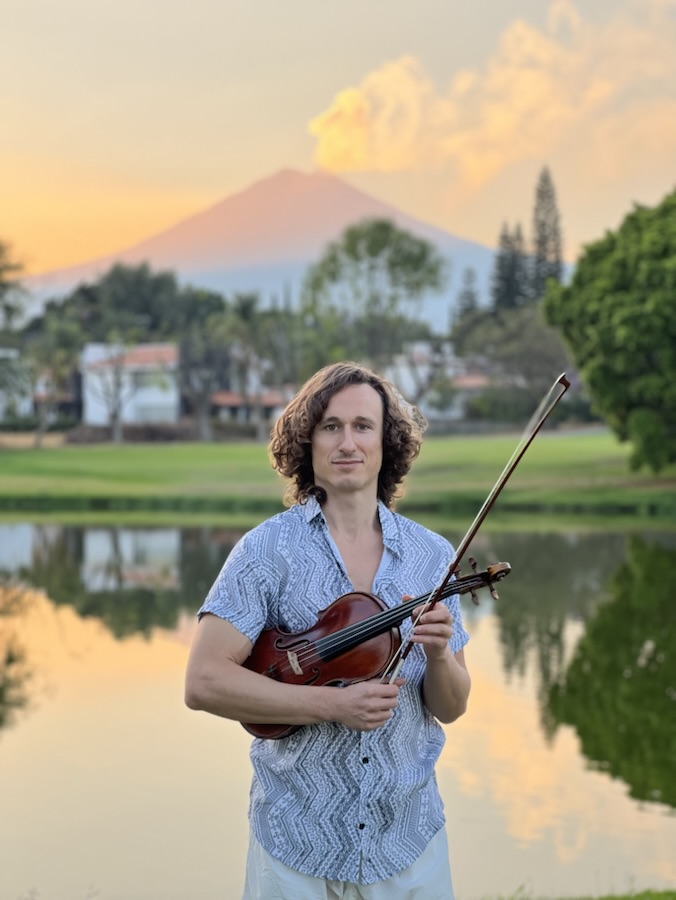
Samuel Wexler holding his violin at dusk in Atlixco, the Popocatépetl volcano behind him

There's no denying that violin is a rather awkward, asymmetrical, and often uncomfortable instrument to play.

  • It's hard to love playing your violin when you're in pain.
  • It's hard to love playing when your inner critic is shouting at you the whole time.
  • It's hard to enjoy practicing when your mind is scattered all over the place.
  • That tight feeling in your neck and shoulders after playing.
  • Stretching it out afterwards, and never quite finding the relief you're looking for.
  • Pre-practice stretches that feel like one more thing to add to an already busy schedule: more obligation than something you look forward to.
  • The stretches may help, to a degree, but they just don't seem to get to the root of the issue.

So the tension becomes a constant, and we start to accept it as normal, even necessary.

Dealing with constant discomfort isn't even the worst part.

What may seem like manageable discomfort for a while can quickly escalate into pain, and full-blown injury, before you know it. Left unaddressed, the same biomechanical issues behind the everyday discomfort can easily spiral.

My friend David, from youth symphony, spent months unable to play. For years his shoulder had been compensating to support the violin, and the imbalance it built up ended in collapsed ribs and a whole chain reaction of problems.

It's not just that playing feels uncomfortable. Living with that discomfort can slowly kill your passion, and burn you out.

Prehab is far better than rehab.

Getting physically injured or burning out will set us back far more time, effort and money than investing in body-mind preparation now. Rehabilitation, physical or motivational, is far more costly than prevention.

Playing the violin you love shouldn't hurt.

My goal is to help you remove the obstacles of physical pain and discomfort, the hypercritical inner voice, and mental distraction, so that you can play united within yourself, from the heart.

Yoga for violinists, not yoga stretches for violinists.

It's tempting to make a course of what most people think of as yoga: stretches for violinists. The deeper I've gotten into my yoga trainings, however, the more I've realized what a robust system yoga is, beyond just the poses, and how much of it is directly helpful to violinists.

The stretches in and of themselves are of course valuable, but they only become yoga when practiced with a certain mindset and internal focus.

Taking care of our bodies is a key aspect of Yoga for Violinists. It absolutely includes stretches and warm-ups, but also goes way beyond just those: a fundamental transformation of how we relate to ourselves, the violin, and music-making.

Any yoga will help your playing: the whole body is connected. This course brings what helps violinists most, as early in the process as possible, including elements you'd usually meet only in advanced trainings.

You won't be trading practice time for yoga. What you learn on the mat comes into the practice room with you, so the practicing you already do starts to feel and work better.

Each set weaves five practices together, each one strengthening the others, and then all of it comes with you into the practice room.

The idea has deep roots. Yehudi Menuhin, one of the greatest violinists of the 20th century, studied yoga with B.K.S. Iyengar, one of the most influential yoga teachers of his era. Menuhin called him

“my best violin teacher.”

Side by side

A stretch routineYoga for Violinists
What it works onYour muscles, one stretch at a timeBody, breath, mind and violin, as one system
WhenBefore and after you play: one more thing on the listBefore you play, and in the playing itself
Your violinSet aside while you stretchIn your hands: violin yoga in every set
TensionStretched out afterwards, until it builds up againWorked on where it starts: how you stand, move, breathe and play
Where it leadsRelief, to a degreeA complete transformation of your relationship with your violin, your body, and your practice

Yoga means union.

Union runs through the whole course, in seven layers:

  1. Your body and your violin
  2. The vibrations of the violin and your body
  3. You and your full desire to play and practice
  4. Your attention, with listening and feeling as you play
  5. You and the larger musical work you're a part of
  6. You and other musicians
  7. You and the people who hear your music

Day/Set 1

The Body as the First Instrument

Even the most magnificent violin makes no sound by itself. Set 1 begins with the instrument that plays it: you.

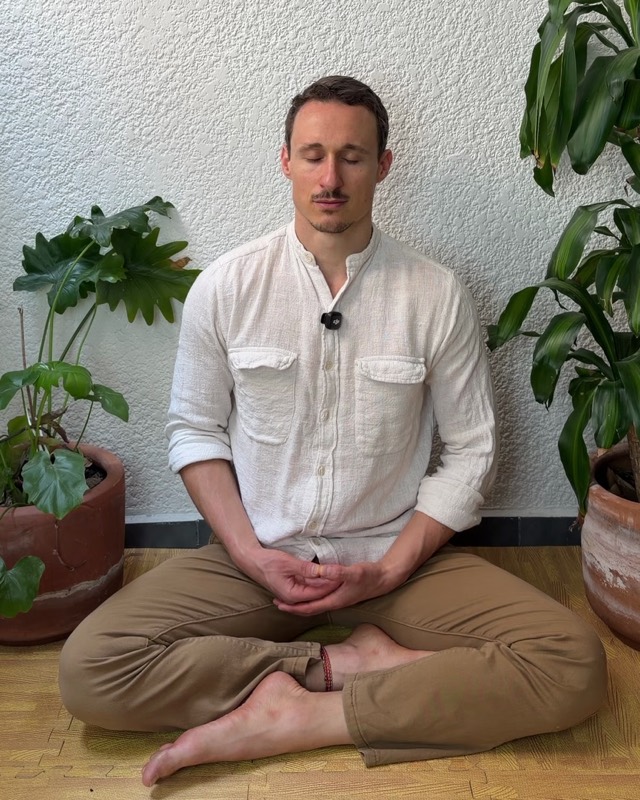
  1. Samuel Wexler seated cross-legged with his eyes closed, between two plants
    Meditation+
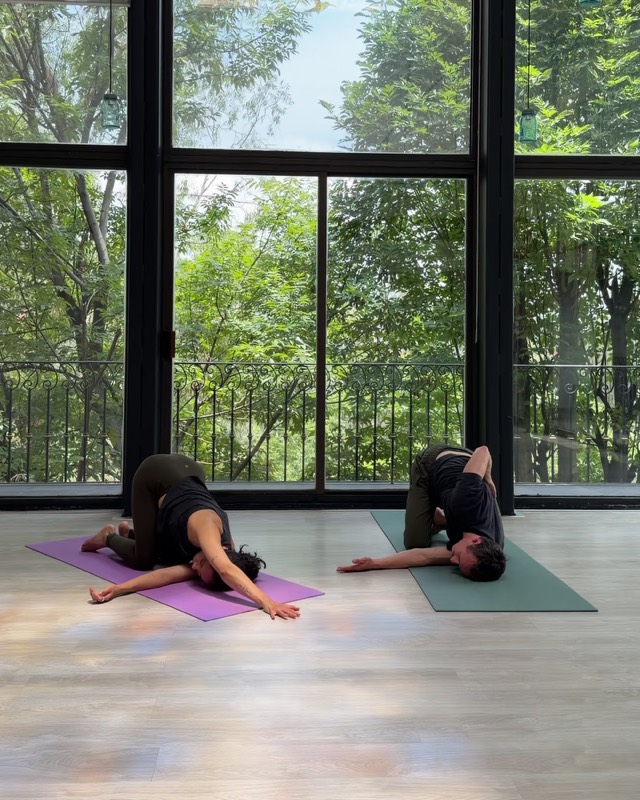
  2. Two people resting in a yoga pose on their mats, by tall windows full of trees
    Asana
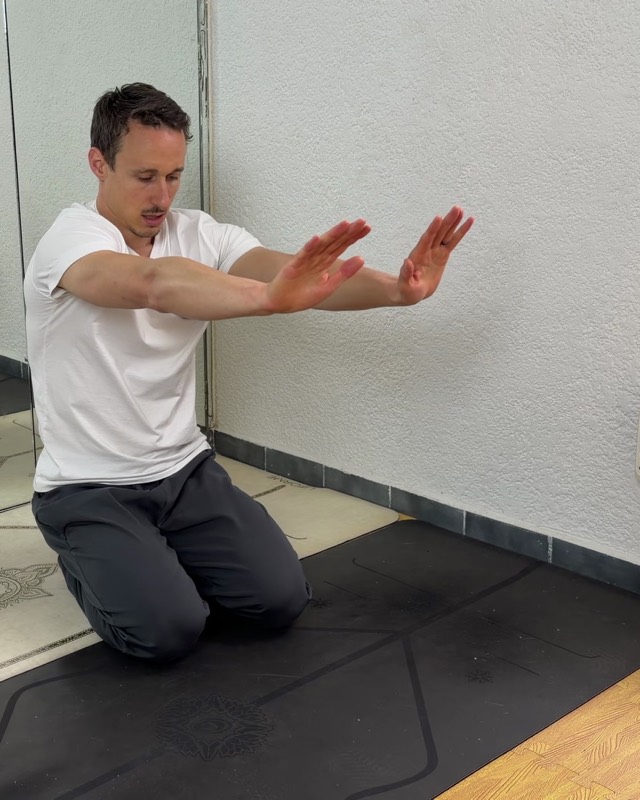
  3. Samuel kneeling on a yoga mat, arms reaching forward, showing the alignment of a pose
    Workshop
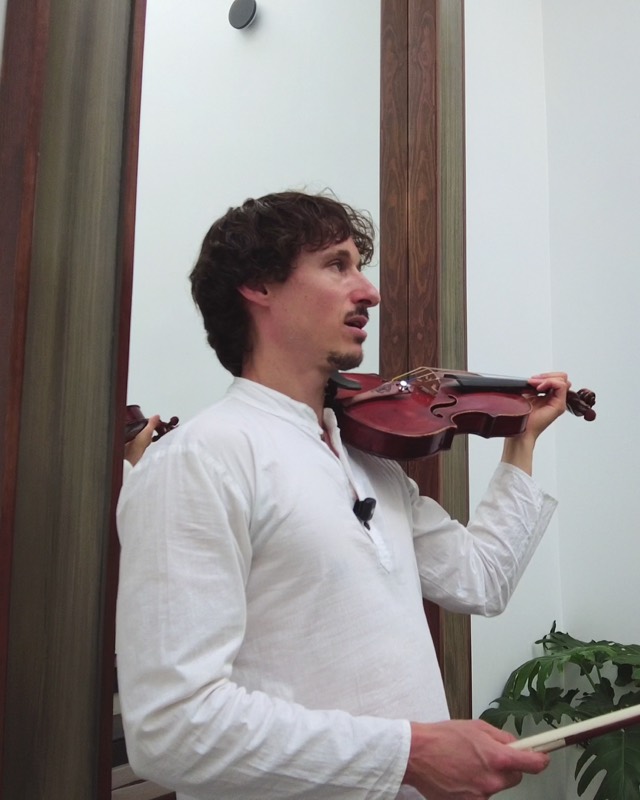
  4. Samuel standing tall with his violin on his shoulder, beside a mirror
    Violin yoga
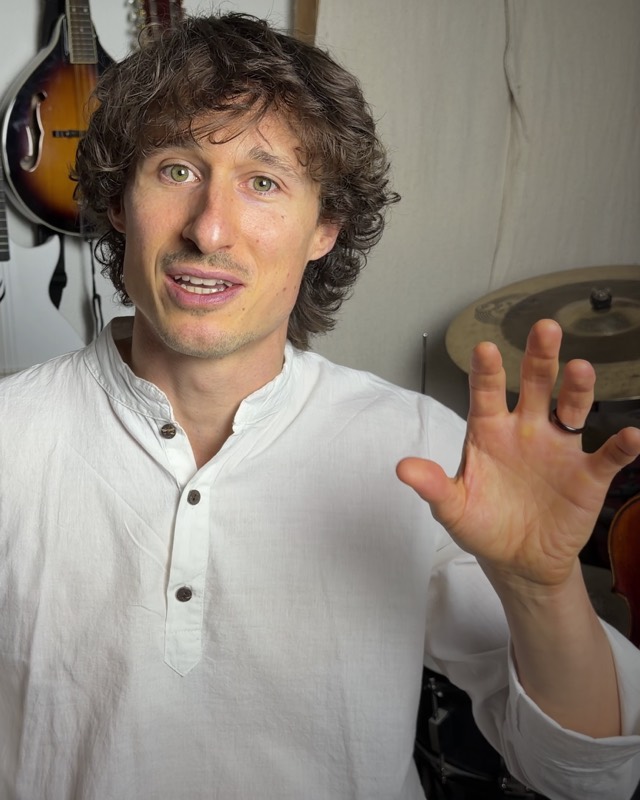
  5. Samuel talking to the camera, a wall of instruments behind him
    Insight
  1. Meditation+A first taste of the body scan meditation that helped me discover my own sound.5 min
  2. AsanaA sequence of yoga poses that tune your body, the first instrument, before you pick up the second.10 min
  3. WorkshopForget "stand up straight and pull your shoulders back." Learn the keys to standing with alignment, balance and ease instead of strain and force, and feel for yourself how good posture can be easier than slouching.15 min
  4. Violin yogaBuild the foundation of a harmonious playing posture, maybe for the first time, so that ease carries into everything you play. It starts before you play a single note.7 min
  5. InsightWhat Heifetz said when an admirer praised his violin's sound, and the "somewhat obvious, but radical shift" this whole course grows from.15 min

Times vary from set to set. Here the violin yoga is about 7 minutes and the workshop about 15; in other sets the violin yoga runs much longer and the workshop shorter, each shaped to that set's theme.

Yoga for Violinists is designed to catalyze immediate shifts in your playing: more comfort and ease within the first day.

It's not necessarily day 1, it's set 1. That set goes together.

Do it in one sitting, or spread it over a few days, one practice at a time. All you need is your violin or viola and a little floor space.

Send me Day/Set 1

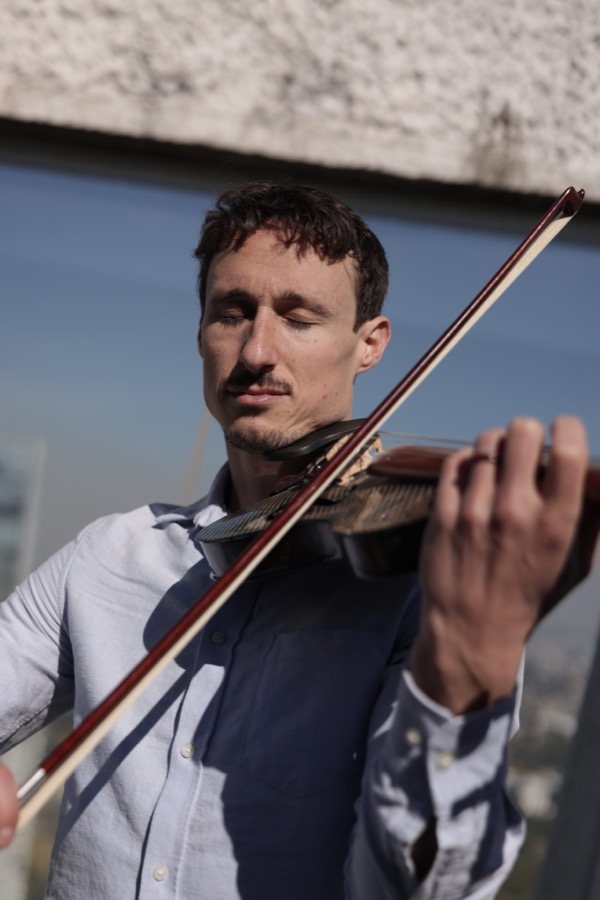
Samuel Wexler playing violin, eyes closed

My story

I used to be extremely rigid.

Playing violin felt constantly uncomfortable.

One of my violin teachers kept smacking me on the shoulder with his bow to remind me to relax it. My neck and shoulders always felt stiff, squeezing the violin, and many technical passages made me anxious.

Then I started practicing yoga, and found that what I was learning on the mat could come into the practice room and address all of it. Today, technical excerpts that once felt totally impossible feel comfortable to play.

I present everything in this course to you, not as someone who has mastered all of it, but as someone who continues to discover how valuable it all is, continues to practice it, continues to integrate it. So I'm very pleased to share this with you, not just as a teacher, but also as a fellow practitioner on this journey with you.

More on this

I'm making this course as much for myself as for anyone else, to clarify everything that I've discovered in various moments at the intersection of yoga and violin for the past 15 years, and to formalize it into something that I can continue to practice with more clarity as well.

I have a long way to go before so many of these things are really fully integrated. Who knows if that integration will ever happen 100%, but I can say beyond a shadow of a doubt that every time I practice in this way, I notice that things are improving: with the playing, with how I feel in my body, with the state of my mind. I know this works.

In the works since 2013

I'm Samuel Wexler, a classically trained violinist and a 500-hour certified yoga teacher.

I was first inspired to make this course during my first yoga teacher training, in 2013, as I saw in real time how much of what I was learning applied to the violin, and how it was improving my playing.

I've been writing down notes ever since, as I practiced and taught both yoga and violin and kept discovering how they complement one another. In 2023 I went to India for my advanced 300-hour training, to deepen my practice and to prepare for making this course.

I wanted to make this course for years. I finally dug in to distill and organize all those notes and all that experience into one comprehensive course.

Beyond classical training, I'm a multi-instrumentalist: I improvise, fuse genres, compose, produce, and perform as a live-looping artist. Hear my music.

Music, wellness and insights have been three pillars of my life. This course is the first project that brings all three together into a cohesive experience.

  • Classically trained, multi-genre violinist
  • 500-hour certified yoga teacher
  • Composer, producer and live-looping artist
  • Multi-instrumentalist

How it works

  1. Confirm your email (check your inbox).
  2. Sign a short participation agreement, the same one every student signs.
  3. Watch a short Start Here video, then begin Day 1 whenever you like.

Questions

I've never done yoga. Is this for me?

Yes. Everything is taught from the ground up, and you work at your own level. No flexibility required.

How long does it take?

Set 1 runs about 50 minutes in five parts. Do it in one sitting, or spread it over a few days: even a few focused minutes at a time count. It's not just another set of warm-ups to add to your practice routine, but the start of a deep transformation of your relationship with the violin, from the inside out.

What do I need?

Your violin or viola, a little floor space (a yoga mat, a rug or a folded blanket) and clothes you can move in.

I play viola. Does it work for me?

Yes, and it may be even more helpful for you. I also play viola and can't deny that the added size and weight of the viola compared to the violin makes it even more unwieldy and strenuous on the body.

Is it for amateurs or professionals?

Both. It's for anyone who wants playing violin to feel better, from amateurs to top-level players.

Isn't any yoga good for violinists?

Yes: the whole body is connected, so everything you learn in any class will probably benefit you. This course is designed to bring what will benefit you most, specifically as a violinist, as early in the process as possible, including elements you'd usually meet only in more advanced trainings.

I'm in pain or injured. Should I do it?

Yoga for Violinists is education, not medical care. If you're injured, in pain or have a health condition, check with a professional who knows your history first, and always stay within what feels right for your body.

Is this religious or spiritual?

No. It's practical and non-dogmatic, and non-religious: there's nothing to believe, only things to try. It applies the essence of true yoga practice to violinists: deeper union within yourself and with your violin, without ever pushing any belief system on you. People of all beliefs are welcome.

What's the catch?

There isn't one. You get the complete first set, and afterwards I'll write to you about the full course (unsubscribe anytime). Of course I'd love for you to go deeper with me in the full course, but if the first set helps you, I'll be happy. It's also the most honest way I know for you to see whether the course is right for you before you buy it. I want to do my part for a healthier, more supportive violin community, and I want you to know I'm on your team.

Why do I want you to fall back in love with your violin?

There are many levels:

  1. I want the moments you spend with your violin to be as healthy and fulfilling as possible.
  2. The violin called to you, and the world needs violinists who love playing with all of their hearts.
  3. Anything done without love is empty, so I want to help you love every second you spend with your violin.
The whole answer

On the surface level, I want you to feel more contentment in your life, to be able to enjoy the blessing of having the violin in your life.

Your life is a short collection of moments spent doing different things. So I want the moments that you spend with your violin to be as healthy and fulfilling as possible.

On a deeper level

If you're a violinist of whatever level, it's because the violin called to you in a certain way. Something about the sound really compelled you, really moved something inside of you, and made you want to be able to draw that sound out for yourself.

We wanted the violin to be our instrument, but we could also say that we wanted to be the instrument of the violin.

String instruments seem to touch the hearts of almost everyone who hears them, and I don't think that we should take that for granted.

In a world with so much stress and darkness, I feel like we really need a family of violinists and string players who love playing with all of their hearts, who are ready to give voice to the violin and touch the hearts of others who need it.

If there wasn't something unexplainably powerful about the sound of the violin family, then why would you have chosen to devote so much of your life to drawing out the sound with your own two hands?

Deeper still

I believe that anything done without love is empty. Even the simplest thing done with love is healing for all of us. So I want to help you love every second you spend with your violin.

That every moment brings you a deeper connection and understanding of both the violin and yourself.

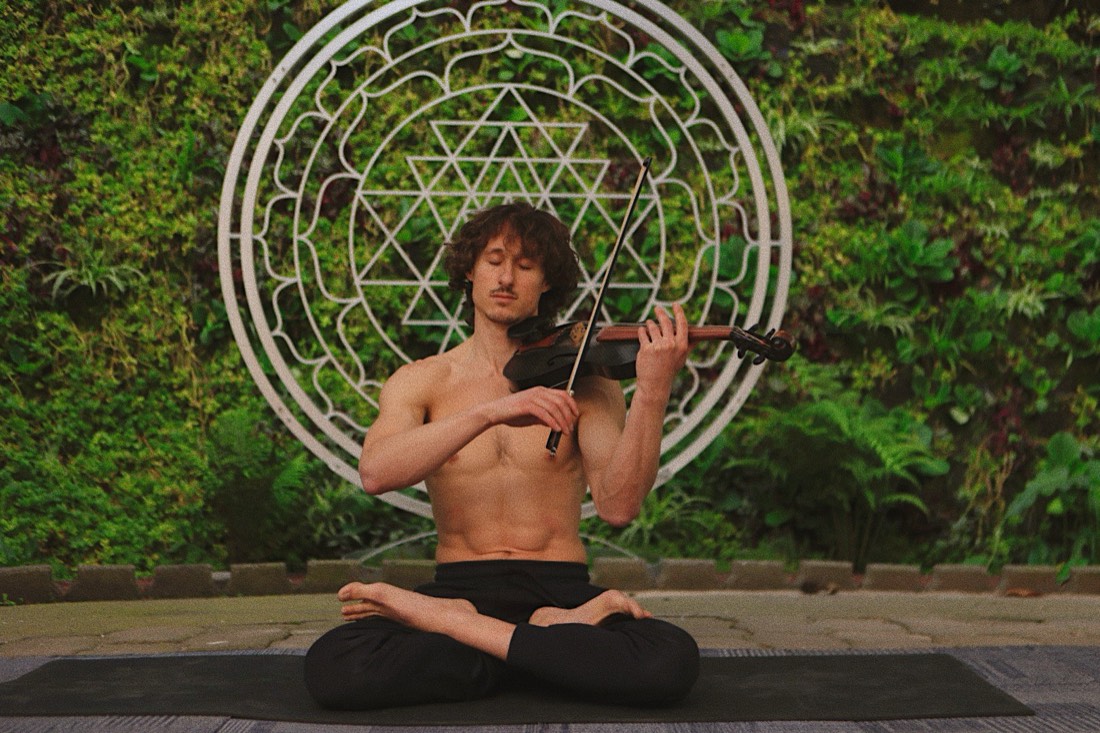
Samuel Wexler seated in lotus pose, playing violin in front of a mandala

Day/Set 1 is ready for you.

Of course I'd love for you to buy the whole course, but I'd be happy just knowing that I gave you something that helped you.

Why give it away?

I want to do something meaningful: to give away something that can make a real difference.

I know that this program will help many violinists to play with more ease and fall back in love with their violins. If it's not the right fit for you personally, though, of course I'd rather you not buy it. The only way to really know is to go through the full course, so the next best thing is a full set, free: enough for at least a decent read on whether the format and the instruction resonate with you before you buy.

The violin community is a group of people I deeply care about. We all felt a strong call to the violin and answered it. We devoted the hours to the relationship and to the skill, and let the violin, and violin culture, shape us in ways only another violinist can understand.

Let's be honest: violin culture has often been one of big egos and fierce competition, and I've been a part of that too.

I want to help build a healthier, more supportive community, in every way, and I want you to know that I'm on your team.

So I'm giving you something of real value, and I hope it makes your life better. Maybe you'll go deeper with me in the full course, which would help support me and my family. Maybe what you learn in the first set will simply help you, and the goodwill will make you want to listen to my music, or support me in some other way. There are no strings attached: you could take the gift and never buy a thing, or even take it and still decide you're not a fan. That's your call, not mine.

Zooming out to what I want to leave in the world: it would feel awesome to know that I poured my heart and soul into a course that can help violinists everywhere, and that even the first set, given as a gift, is something I left behind for all of us.

I'm ready to dive into the full 21-Day Course!